


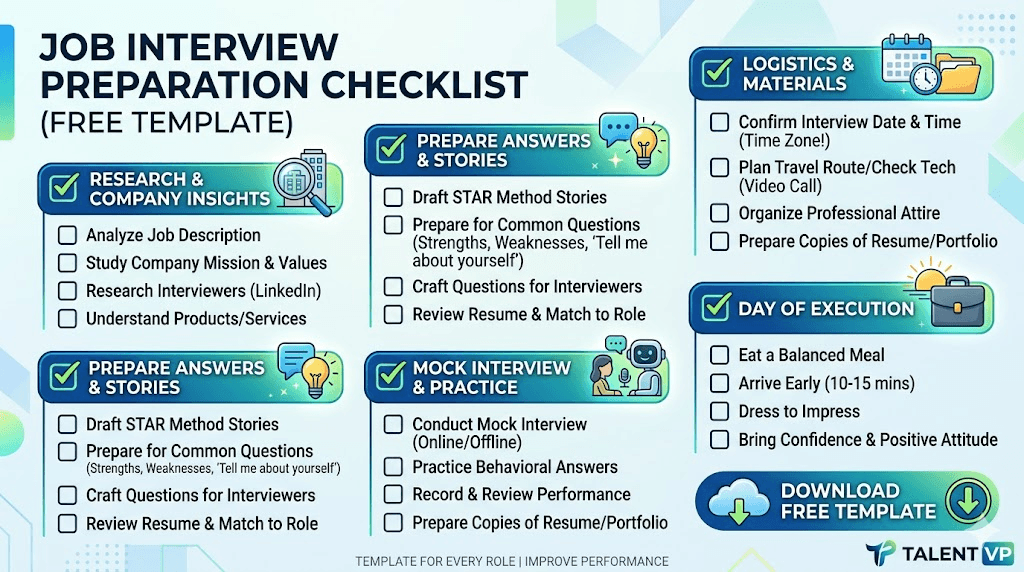
Job Interview Preparation Checklist (Free Template)
Quick Answer
A job interview preparation checklist ensures you address every preparation layer — not just answer rehearsal. Recruiters consistently identify unprepared candidates within the first three minutes through specific observable signals: absent company context, unstructured answers, and underprepared logistics. This checklist covers five stages: company and role research, answer preparation, logistics and format, mental readiness, and day-of execution. Begin at least 48 hours before your interview for every stage to integrate properly.
Most candidates prepare for questions.
The checklist determines whether you prepared for the interview.
What Recruiters Actually See When Candidates Are Underprepared
Underprepared candidates believe their gap is invisible.
Recruiters identify it through precise observable signals.

Preparation is not about having the right answers.
It is about having the right architecture in place before you walk in.
The Job Interview Preparation Checklist
Stage 1 — Company & Role Research (48–72 Hours Before)
- Read the job description three times: once for tasks, once for required skills, once for culture signals embedded in the language
- Research the company's mission, recent news (last 6 months), product or service portfolio, and primary competitors
- Identify your interviewer on LinkedIn — note their role, tenure, and background where relevant
- Map your three strongest achievements directly to the requirements listed in the job description
- Identify one specific and genuine aspect of the company that motivates your application — this becomes your "why this company" answer foundation
Weak: "They seem like a solid company and the role sounds interesting."
Strong: "Their expansion into the DACH market last year aligns directly with my last two years of cross-regional stakeholder work — the role requires exactly that experience."
Research converts generic answers into role-specific evidence.
Recruiters notice the difference immediately.
Stage 2 — Answer Preparation (24–48 Hours Before)
- Prepare a 90–120 second "Tell me about yourself" answer using the Present → Past → Future structure
- Write out five STAR-structured behavioral answers covering: conflict, failure, leadership, delivery under pressure, and cross-functional collaboration
- Prepare a concrete "Why this company?" answer grounded in research from Stage 1
- Prepare a forward-looking "Why are you leaving?" answer — no complaint framing
- Draft 3–5 questions to ask the interviewer (role-specific, not compensation-focused at this stage)
- Confirm your salary expectation range if the role or company is likely to raise it
Structural check: Each behavioral answer must contain a measurable result or observable outcome. An answer that ends before the result is structurally incomplete — and recruiters score it that way.
Writing answers out forces structural clarity.
Thinking them through produces comfortable but unverified preparation.
Stage 3 — Logistics & Format Preparation (24–48 Hours Before)
- Confirm the interview format: video call, phone screen, in-person, panel, or technical assessment
- For video: test camera framing (eye-level), lighting (front-facing), audio (no echo), background (neutral), and internet stability
- For in-person: confirm the full address, estimated travel time, parking availability, and building entry process
- Plan to arrive or log in 5–10 minutes before the scheduled start — never more, never less
- Prepare physical materials if required: printed CV copies, portfolio samples, or reference list
- Confirm appropriate dress code against company culture signals from research
- Set a calendar block and reminder to protect the interview window
Logistics failure is the fastest way to undermine a strong candidate impression.
Infrastructure is not a minor detail — it is a performance precondition.
Stage 4 — Mental Preparation (Evening Before)
- Review your answer frameworks once — structure only, not scripted text
- Identify your three strongest STAR stories — these are your foundation examples
- Prepare a frame for unexpected questions: Situation → Honest assessment → Structured response
- Set a firm preparation stop time — late-evening overpreparation increases answer rigidity, not readiness
- Sleep: cognitive performance, language fluency, and emotional regulation degrade meaningfully below seven hours
- Write down three specific, role-relevant reasons you are the right candidate — not generic strengths
You are not preparing to be perfect.
You are preparing to be clear and structured under real pressure.
Stage 5 — Day-of Execution Checklist
- Review your three foundation stories one final time — structure only, not word-for-word
- Eat a complete meal at least 90 minutes before the interview
- Arrive or log in 5–10 minutes early
- Bring a notepad and pen — note-taking during interviews signals active listening and engagement
- At the opening: confirm how much time the interviewer has allocated — calibrate your answer length accordingly
- Consciously slow your delivery by approximately 15% — anxiety accelerates speech, clarity requires deliberate pacing
- At the close: ask about next steps, the decision timeline, and whether there is anything additional they need from you
Execution is preparation under observation.
The checklist gave you the structure — the interview reveals whether that structure holds.
How Recruiters Evaluate Interview Preparation Level
Most candidates treat interview questions as isolated performance prompts.
Recruiters use them as diagnostic instruments for preparation quality.

Preparation is the difference between performing and demonstrating.
Why the Checklist Alone Does Not Close the Gap
Reading a checklist activates awareness.
It does not activate performance under pressure.
Three distinct gaps persist when preparation stays theoretical and is never rehearsed under simulated conditions:
Recall collapse. STAR-structured answers that candidates know on paper frequently deteriorate into unstructured narrative when asked under live interview conditions. The architecture disappears under stress without prior timed rehearsal.
Pacing errors. Candidates who have not rehearsed answers aloud consistently over-run or under-deliver their target length. Both signals register with recruiters as preparation deficiencies.
Follow-up brittleness. Answers built from memorized scripts break when interviewers probe further. Answers built from frameworks — practiced under realistic pressure — hold structure under follow-up questions because the candidate understands the content, not just the sequence.
Some candidates use structured mock interview platforms such as TalentVP to rehearse under simulated interview conditions before the real interview, receiving objective scoring on structure, specificity, and delivery quality.
6-Step Improvement Plan for Consistent Interview Performance
Step 1: Complete Stage 1 research 72 hours before the interview
Company research integrated into your answers requires processing time. Starting 72 hours out gives you two full days to move information from research into structured examples.
Step 2: Write your STAR answers — do not just think them
Written answers expose structural gaps that mentally rehearsed answers conceal. A behavioral story that feels solid in your head frequently has a missing result, unclear ownership, or overlong situation framing when committed to text.
Step 3: Record yourself answering three core questions
Listen once. Assess pacing, result clarity, and whether the answer could be shorter. Most candidates identify one critical structural or delivery flaw in the first playback session.
Step 4: Run at least two timed mock interview sessions
Simulated interview pressure is the only reliable environment for testing answer performance. Answers that are theoretically solid frequently reveal timing, delivery, or coherence issues only under timed rehearsal conditions.
Step 5: Complete the logistics checklist the evening before — not the morning of
Technology checks, route confirmations, and document preparation completed 12+ hours before the interview eliminate same-day stress variables that measurably degrade cognitive performance during the interview itself.
Step 6: Treat the day-of checklist as a non-negotiable pre-performance sequence
Execute it sequentially and completely. Selectively following checklists produces the same outcome as not following them — gaps in preparation architecture emerge exactly where the checklist was skipped.
Frequently Asked Questions
How far in advance should I start preparing for a job interview?
Begin Stage 1 (company and role research) at least 48–72 hours before the interview. Complete answer preparation at least 24 hours before. Leaving preparation to the evening before is the most common driver of rigid, underperforming interview answers — the answers feel complete but have not been tested under realistic conditions.
What should be on a job interview preparation checklist?
A complete job interview preparation checklist covers five stages: company and role research, structured answer preparation (including STAR behavioral answers), logistics and format confirmation, mental readiness preparation the evening before, and a day-of execution routine. Missing any of these stages creates a preparation gap that becomes observable during the interview.
How do I prepare behavioral interview answers using the STAR method?
Build five core STAR stories covering: conflict, failure, leadership, delivery under pressure, and collaboration. Each story must include a measurable result or observable outcome. Write them out — do not just rehearse mentally. A written STAR answer exposes structural gaps that mentally rehearsed versions conceal. Then practice delivering each story aloud within a 90–120 second target.
What questions should I ask at the end of a job interview?
Prepare 3–5 role-specific questions. Strong examples: "How does the team measure success in this role in the first 90 days?" or "What is the biggest challenge someone stepping into this role will face?" Avoid generic questions about company culture or compensation at this stage — they signal low role-specific engagement.
What is the most common job interview preparation mistake?
Over-preparing answers while under-preparing company research and logistics. Strong interview performance requires all five checklist stages functioning together. Candidates who have polished answers but have not researched the company or confirmed technical logistics consistently underperform their preparation level on the day of the interview.
Interviews are performance evaluations.
The checklist is your preparation architecture.
Architecture determines the ceiling of what execution can reach.
Put This Into Practice
You've just read the framework.
Now test it under pressure.
TalentVP gives you AI mock interviews adapted to your role,
structured STAR feedback with scores,
and CV analysis that shows what recruiters actually see.
Your first interview is free.
→ talentvp.com
🌐 Read this guide in: English | Deutsch | Türkçe


