


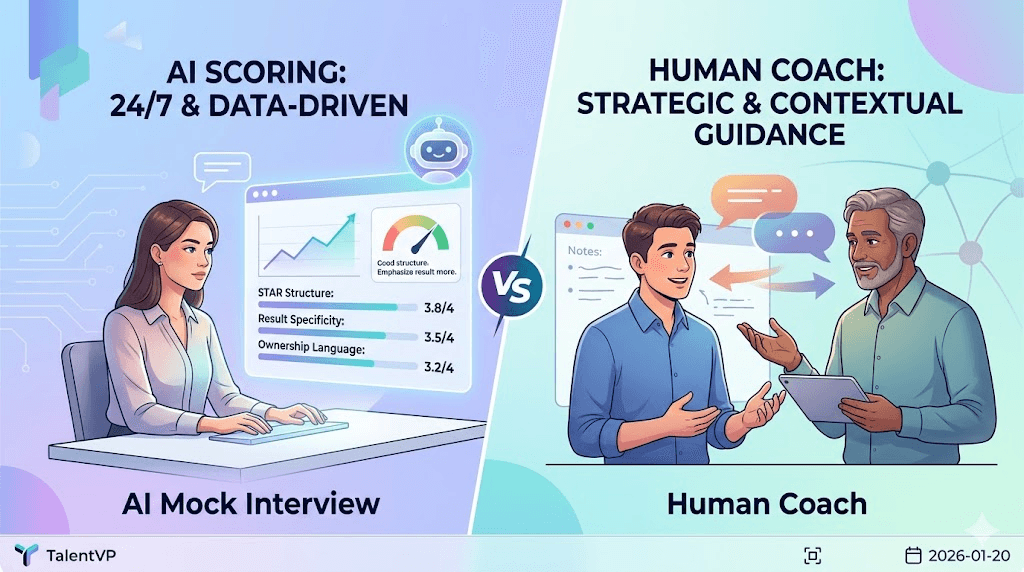
AI Mock Interviews: Are They Better Than Human Coaches?
Quick Answer
AI mock interviews are structured practice sessions where candidates deliver interview responses and receive automated, dimension-specific feedback scored against consistent evaluation criteria. They do not replace human coaches — they serve a different function in the preparation process. AI provides repeatable, objective scoring at scale; human coaches provide contextual strategy, industry-specific insight, and nuanced judgment that AI cannot replicate. For most candidates, the most effective preparation combines both: AI for structured repetition and gap identification, human coaching for strategic refinement before high-stakes interviews.
The question is not which is better. The question is which does what — and when.
What Is an AI Mock Interview?
An AI mock interview is a structured practice simulation where a candidate delivers interview responses and receives automated evaluation against predefined behavioral scoring criteria. In the context of interview preparation, this means candidates receive specific, actionable feedback on structural completeness, verbal specificity, ownership language, and result orientation — the same dimensions structured interviewers apply — without scheduling constraints, cost barriers, or inconsistency between sessions.
What distinguishes effective AI mock interview platforms from simple question generators is the scoring architecture: the ability to evaluate answers across multiple performance dimensions simultaneously, rather than returning a binary pass/fail result. This granular diagnostic is the core value proposition — and the primary reason AI practice outperforms unstructured self-review for identifying specific performance gaps.
The technology delivers the feedback. The scoring framework determines whether the feedback produces improvement.
How Recruiters Actually Evaluate Interview Performance
Most candidates assume interviews are conversations. Recruiters treat them as scored performance evaluations.
Understanding the evaluation logic recruiters apply — and that AI mock interview platforms operationalize — is what separates preparation that produces measurable improvement from preparation that produces only familiarity.

This is the Structure → Specificity → Ownership → Result evaluation framework. Recruiting teams using structured rubrics score each answer dimension independently on a 1–4 scale. AI-powered mock interview platforms apply this same rubric programmatically — providing consistent, objective scoring that mirrors the structured interviewer's evaluation logic.
Structured evaluation predates AI. AI makes it available to every candidate, at every session.
AI Mock Interviews vs Human Coaches: What Each Does Best
The comparison between AI and human coaching is not zero-sum. They optimize for fundamentally different preparation needs.

Neither format wins outright. The question is which tool serves which preparation stage.
Where AI Practice Outperforms Human Coaching
Repetition without cost escalation. A candidate who needs to practice the same scenario twelve times before structural corrections transfer to unrehearsed delivery cannot afford twelve coaching sessions. AI removes this constraint entirely. Structured repetition, at volume, becomes accessible.
Scoring objectivity. Human coaches — even excellent ones — are subject to halo effects, personal stylistic preferences, and session-to-session inconsistency. A structurally identical answer delivered on Monday versus Thursday may receive meaningfully different feedback from the same coach. AI applies the same rubric every time.
Baseline measurement. Before strategic refinement has value, a candidate needs an objective performance baseline — which dimensions are strong, which are weak, and what the gap magnitude is. AI scoring provides this in the first session, enabling everything that follows to operate on data rather than impression.
For a structured approach to maximizing each mock session, see our guide on online mock interview practice.
Where Human Coaching Outperforms AI
Company-specific strategy. A coach who has worked with candidates at your target company, understands the interview panel composition, and recognizes the cultural signals that matter in that specific context provides insight no AI system can replicate without that data.
Interpreting ambiguous questions. Interviewers frequently ask questions where the intent differs from the literal wording. Experienced coaches recognize these patterns and teach candidates to identify and respond to the underlying evaluation intent — not just the surface question.
Emotional performance calibration. Interview anxiety manifests differently across candidates. A coach who observes behavioral signals in real time — and adjusts the session accordingly — addresses a performance dimension that structured scoring cannot touch.
Weak vs Strong: The Scenario Where Combination Wins
Candidate using only self-preparation before a senior-level interview:
Three weeks of reading and note-taking. Solid knowledge of the role and company. Prepared answers for the top twelve behavioral questions. First structured external evaluation: average score 2.1 out of 4. Primary gap: missing result statements and passive team-framed language.
Same candidate using AI practice followed by one human coaching session:
Session 1 — Baseline: average 2.1/4. Two gaps identified. Session 2 — Targeted correction on results and ownership. Average improves to 2.9/4. Session 3 — Full simulation with unknown questions. Score holds at 2.8/4. One answer collapses under genuine uncertainty. Human coaching session — Coach identifies the collapsing story, reconstructs it, adds company-specific framing and positioning differentiation. Candidate enters the interview with data-backed confidence rather than general anxiety.
Self-preparation generates familiarity. AI practice generates measurement and correction. Human coaching generates strategy. The sequence is what produces the outcome.
The Structured Approach Used by Interview Coaches
Coaches who consistently produce measurable candidate improvement do not rely on general encouragement. They apply a systematic diagnostic process that mirrors the evaluation criteria of structured interviewers.
The most commonly applied model is the CAR-E Framework — Context, Action, Result, Earned Insight. This extends the traditional STAR model by adding a fifth element: the Earned Insight, which forces the candidate to articulate a specific, durable learning from the experience. The Earned Insight serves two functions: it differentiates the answer from generic STAR responses, and it signals learning agility — a criterion weighted heavily in senior and leadership-level interviews.
Professional coaches apply this framework by first diagnosing which dimensions fail under pressure, then designing targeted correction scenarios that force practice specifically in the gap area — not across all dimensions simultaneously. This targeted approach is more efficient than broad practice and produces faster score improvement in fewer sessions.
Modern AI coaching platforms now evaluate answers across six distinct dimensions — communication clarity, answer substance, technical accuracy, professionalism, problem-solving structure, and differentiation quality — providing a granular diagnostic baseline that traditional holistic impression scoring cannot produce. This multi-dimensional measurement enables interview coaches to focus session time on the specific dimensions where a candidate is systematically weak, rather than spending session time on basic structural discovery that a scored AI session could have surfaced in minutes.
According to TalentVP's analysis of interview coaching patterns, candidates who arrive at human coaching sessions with documented AI scoring data — rather than subjective self-assessment — enable coaches to invest session time in strategic refinement rather than structural diagnosis. The outcome is a measurably different conversation: coaching focused on "how to position this experience for this specific company" rather than "you need to include the result in your answers."
Effective preparation is not broad practice. It is targeted correction of identified gaps — at volume.
Why Self-Preparation Has a Ceiling
The Knowledge-Performance Gap
Candidates who prepare alone consistently overestimate the clarity of their own answers. An answer that feels detailed — because the speaker internally re-experiences the full context — often contains almost no usable specificity for an interviewer hearing it without that context.
This is a structural limitation of self-practice, not a motivation problem. The candidate cannot perceive the information gap they are creating because they already possess the information they believe they are communicating.
Reading about structured answers prepares cognition. It does not prepare performance under evaluation.
The Self-Assessment Blind Spot
A growing number of structured AI interview practice platforms now incorporate calibrated self-assessment: candidates score their own answer immediately before receiving the AI evaluation. The comparison between self-score and objective score consistently surfaces systematic patterns — over-confidence in delivery quality, under-confidence in answer substance, or misaligned understanding of what recruiters actually score. These patterns are invisible in solo practice. They surface immediately when an objective external score exists for comparison.
This mechanism — systematic gap identification through self-assessment calibration — is what enables structured AI practice to produce faster improvement than unstructured repetition, regardless of volume.
The Format Selection Matrix

6-Step System: How to Use AI and Human Coaching Together
Step 1: Build your STAR story bank in writing Construct written STAR answers for 8–10 behavioral questions before any practice format. Cover: conflict resolution, failure and recovery, leadership demonstration, performance under pressure, and role motivation. Written construction forces structural clarity before delivery introduces cognitive load. For a complete STAR-building guide, see how to answer behavioral interview questions using the STAR method.
Step 2: Run your first AI session as a raw baseline measurement Deliver your prepared answers on an AI-scored platform without optimizing first. The goal is an honest baseline: which dimensions are strong, which are systematically weak, and how large each gap is. This data eliminates guesswork from everything that follows.
Step 3: Identify and isolate your two weakest dimensions Locate the two dimensions with the lowest scores. Common profiles include: strong structure with weak result precision, or strong specificity with weak first-person ownership language. Design the next two to three AI sessions exclusively around correcting those two dimensions — not practicing broadly across all categories.
Step 4: Complete targeted AI sessions until scores stabilize above 3.0/4 In each session, apply the specific corrections identified in Step 3. Compare scores session-to-session. Stagnation after two sessions indicates the underlying story needs reconstruction — not just delivery correction.
Step 5: Schedule human coaching for strategic refinement Once AI scores hold consistently above 3.0/4 across all dimensions, the structural baseline is solved. Human coaching is now positioned to deliver its highest value: company-specific strategy, positioning differentiation, and pre-interview confidence calibration for the specific stakes of your target role.
Step 6: Final AI simulation with unknown questions within 48 hours of the interview Complete a full AI mock session with questions you have not pre-selected. This validates whether improvements transfer to genuine uncertainty — not just rehearsed scenarios. Any story-to-question mapping gaps that surface can be corrected before the actual evaluation. For a complete pre-interview countdown, see our interview preparation checklist.
Frequently Asked Questions
Are AI mock interviews as effective as human coaches?
AI mock interviews and human coaches are effective at different things. AI provides consistent, objective, dimension-specific scoring at unlimited scale — making it superior for gap identification, structural correction, and repetition volume. Human coaches provide company-specific strategy, nuanced interpretation of ambiguous questions, and emotional calibration. The most effective preparation combines both in sequence: AI for structured baseline measurement and correction, then human coaching for strategic refinement once the structural foundation is solid.
What makes an AI mock interview platform worth using?
An effective AI mock interview platform provides dimension-specific scoring rather than binary pass/fail feedback, consistent evaluation criteria across sessions so improvement is measurable, self-assessment calibration where you rate your answer before seeing the AI score, and question variety covering behavioral and role-specific categories. AI-powered platforms like TalentVP provide structured dimension scoring, behavioral analysis, and personalized feedback that mirrors professional coaching methodology — enabling multiple targeted practice cycles before investing in human coaching sessions.
How many AI sessions should I complete before scheduling a human coach?
Three to five structured AI sessions are sufficient for most candidates to close primary dimension gaps before human coaching adds its maximum value. The threshold to target before scheduling a coaching session is consistently scoring 3.0 or above across all behavioral dimensions. At that point, structural basics are solved and coaching session time is invested in strategic differentiation — the higher-value use of an expensive hourly resource.
Can AI mock interviews detect interview anxiety?
Current AI mock interview systems evaluate content structure, verbal specificity, and language patterns — not physiological or emotional signals. AI scoring identifies structural performance; it does not evaluate tone anxiety, pacing irregularities, or confidence signals the way an experienced human coach can in a live session. For anxiety-specific performance calibration, human coaching remains the more effective format.
Is investing in both AI practice and human coaching worth it for most candidates?
For high-stakes interviews — senior roles, career transitions, or positions with significant compensation impact — the combination consistently produces better outcomes than either format alone. AI practice closes structural gaps efficiently at low cost. Human coaching then addresses strategic differentiation, which is the variable that separates interview-ready candidates from competitive ones. The sequencing is what produces the return: measure first, correct second, strategize third.
Interviews are scored performance evaluations. AI practice measures the performance. Human coaching refines the strategy. Both serve the outcome — in the right sequence.
Put This Into Practice
You've read the comparison. Now establish your baseline.
TalentVP gives you AI mock interviews adapted to your role, dimension-specific STAR feedback with scores, and CV analysis that shows what recruiters actually see.
Your first interview is free.
→ talentvp.com


